
AI Therapist: What It Is, How It Works, and Whether It Actually Helps
An AI therapist is an AI-powered chat that listens, helps you make sense of what you’re feeling, and walks you through evidence-based coping techniques — any time, day or night. You can talk to an AI therapist right on this page, for free, with no sign-up. Researchers at Stanford HAI note that tools like this exist largely because access to real therapy is so limited.
It is not a licensed clinician and not a crisis service — but used well, it’s a private, always-available first step for stress, anxiety, low mood, and simply thinking things through.

What is an AI therapist?
A plain-language definition
An AI therapist — also called an AI therapy chatbot, AI mental health chatbot, or AI wellness companion — uses a large language model (LLM) to hold a supportive, therapy-style conversation. It reflects back what you say, asks gentle follow-up questions, and suggests coping strategies drawn from established clinical methods. The reason these tools exist isn’t hype: nearly half of people who need therapy can’t easily get an appointment, and an AI therapist tries to help fill that gap between sessions or while someone is on a waitlist.
What it is NOT
An AI therapist is not:
- A licensed therapist, psychologist, or psychiatrist
- A way to get a clinical diagnosis
- A source of prescription medication
- A crisis line or emergency service
Being upfront about that distinction matters — mental health is a sensitive, high-stakes topic, and any tool in this space should set expectations honestly before the first message is even sent.
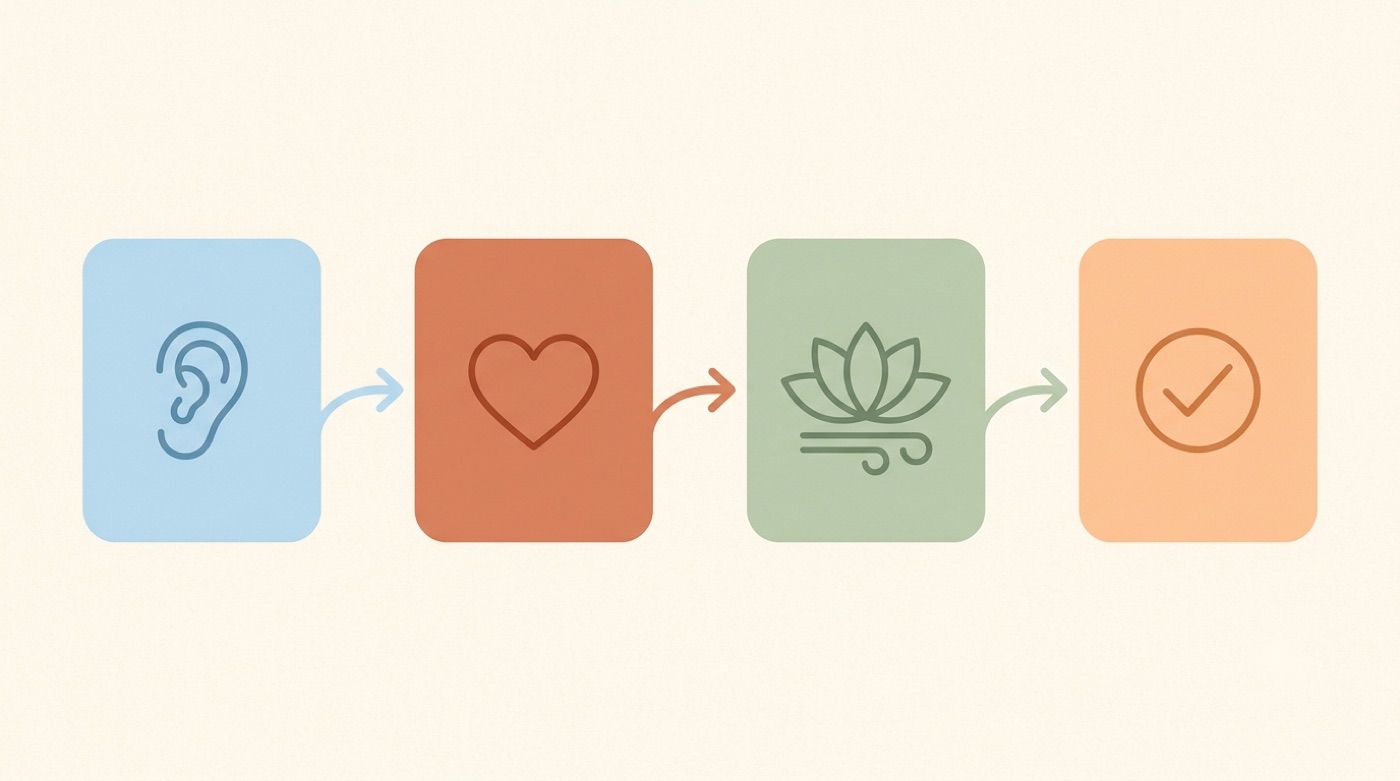
How an AI therapist works
An AI therapy chatbot doesn’t just generate generic chit-chat — it’s built around specific, evidence-based frameworks.
The technology: language models trained on therapeutic techniques
Natural language processing and large language models generate responses grounded in established therapeutic methods, primarily Cognitive Behavioral Therapy (CBT) and Dialectical Behavior Therapy (DBT). A well-built AI therapist can remember key details across a conversation — what stressed you out last week, what coping technique helped — and tailor its suggestions accordingly instead of starting from zero every time.
| Framework | What it contributes |
|---|---|
| Cognitive Behavioral Therapy (CBT) | Identifying and reframing unhelpful or distorted thought patterns |
| Dialectical Behavior Therapy (DBT) | Skills for managing intense emotions and tolerating distress |
| Guided breathing techniques | Calming the nervous system in the moment (4-7-8, box breathing) |
| Mood tracking | Surfacing patterns over days and weeks instead of one conversation at a time |
What a first session usually looks like
A typical first conversation with an AI therapist follows a loose but recognizable pattern:
- You describe what’s on your mind in your own words — no forms, no intake paperwork
- The chatbot reflects back what it heard, to confirm it understood correctly
- It asks a few gentle follow-up questions to understand the situation and how long it’s been going on
- Together you land on one coping technique to try, such as a breathing exercise or a thought-reframing question
- You practice it in the chat, in real time, rather than being told about it in the abstract
- The chatbot offers a short reflection summary of what was discussed and what to try next
- Your mood and key details are saved, so the next conversation can pick up where this one left off
The tone is meant to be a calm, judgment-free back-and-forth, closer to a conversation than a rigid script or quiz.
Does an AI therapist actually work?
This is the question that matters most, and it’s no longer purely theoretical — there’s a randomized controlled trial to look at.
What the research shows
Dartmouth Geisel School of Medicine ran a randomized controlled trial of a generative-AI therapy chatbot called Therabot, with 106 participants in the treatment group and 104 in a waitlist control group. Over an 8-week period, participants who used Therabot saw average symptom reductions of 51% for depression, 31% for anxiety, and 19% for eating-disorder and body-image concerns. Notably, around six hours of total chatbot use produced outcomes the researchers compared to roughly eight sessions of outpatient therapy. The trial was published in NEJM AI on March 27, 2025.
Critically, people reported a degree of “therapeutic alliance” in line with what patients report for in-person providers, the study found.
Dartmouth Geisel School of Medicine, Therabot trial
Beyond this single trial, broader reviews of AI mental health chatbots have found benefits across mood, stress levels, and sleep quality, even if effect sizes vary by study design and population.
Why it can help
An AI therapist is available the instant you need it — at 2 a.m., during a lunch break, mid-panic attack — with a low barrier to starting and a level of privacy some people find easier than sitting across from another person. It doesn’t get tired or impatient. For building coping skills and everyday self-reflection, that combination of availability and patience is genuinely useful, whether as a supplement between formal sessions or, for milder concerns, as a first step on its own.

What can an AI therapist help with?
Everyday emotional support
People turn to AI therapy chat for a fairly consistent set of everyday struggles:
- Anxiety and stress that build up over the course of a day
- Low mood and overthinking that’s hard to talk through with people nearby
- Relationship worries, from friction with a partner to family tension
- Self-esteem and confidence issues
- Sleep problems and burnout
- Simply processing a hard day before it turns into a hard week
Where it fits best
An AI counselor fits best with mild-to-moderate everyday struggles and general skill-building — learning to catch a spiraling thought, practicing a breathing technique, getting a mood pattern out of your head and onto a page. It is not built, and should not be relied on, for severe or acute psychiatric conditions.

Is an AI therapist safe? Limits you should know
The honest limitations
Stanford HAI researchers studied several popular AI therapy and companion chatbots and found real gaps:
- In some tests, bots failed to appropriately intervene when a user showed signs of a mental health crisis
- In others, they reflected stigma toward certain conditions instead of responding helpfully
- Across the board, researchers note that these tools can be wrong and cannot replace the human connection at the core of real therapy
An AI therapist should assist professional care, not substitute for it — a point worth repeating precisely because these products are so easy to open on a hard night.
If you’re in crisis — get human help now
If you are in crisis or thinking about harming yourself, do not rely on an AI therapist. Contact the 988 Suicide & Crisis Lifeline — call or text 988 in the US, available 24/7 — call 911, or go to your nearest emergency room. You can also visit 988lifeline.org directly, and the NIMH Find Help page lists further resources for locating professional mental health care.
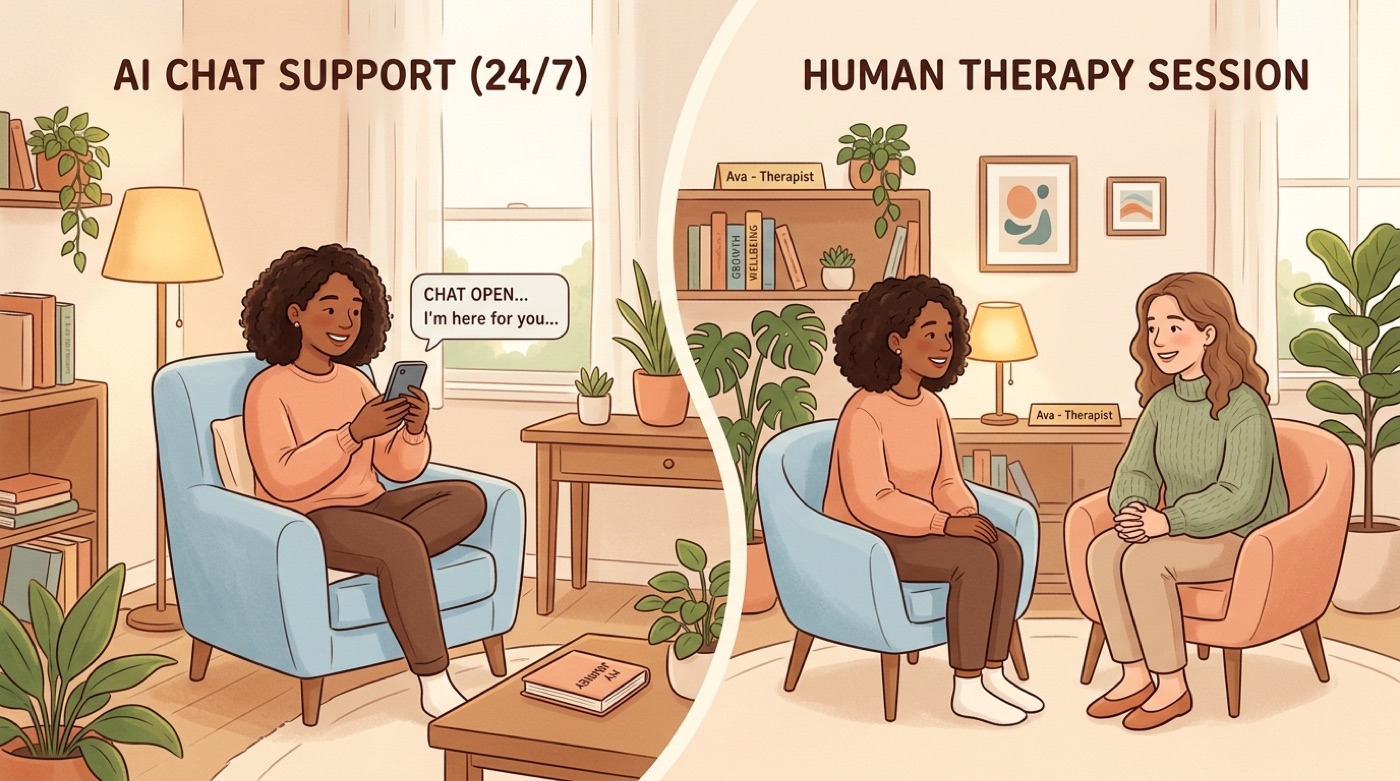
AI therapist vs a human therapist
A simple comparison
The two aren’t really competing for the same job — an AI therapist and a licensed clinician are strongest in different situations.
| Factor | AI therapist | Human therapist |
|---|---|---|
| Availability | 24/7, instant | Scheduled appointments |
| Cost | Often free or low-cost | Typically $100–$200+ per session |
| Privacy | High — anonymous, no waiting room | Confidential, but requires disclosure to a person |
| Depth of treatment | Surface-level coping and reflection | Can address complex, long-term issues |
| Diagnosis & medication | Not possible | Yes, by a licensed clinician |
| Crisis handling | Not equipped — refer to 988/911 | Trained for crisis intervention |
When to see a licensed professional
A licensed clinician, not an app, is the right call when:
- Symptoms are persistent or getting worse over weeks
- Past trauma is involved
- There are any safety concerns for you or someone else
- You need a formal diagnosis or medication
An AI wellness companion complements that kind of care; it isn’t a substitute for it.
How much does an AI therapist cost?
Free and paid options
Cost is one of the biggest practical differences. Many AI therapy platforms, including the chat on this site, offer a free tier with no sign-up required, while some apps add optional low-cost subscriptions for extra features. That stands in sharp contrast to in-person therapy, where a single session commonly runs well over $100 and a course of treatment can add up to a real financial commitment, especially without insurance coverage.
Frequently Asked Questions
- What is an AI therapist?
An AI-powered chat that listens and guides you through evidence-based coping techniques 24/7 — supportive self-help, not a licensed clinician.
- Is there a free AI therapist?
Yes — you can start for free on this page with no sign-up; some apps add optional paid tiers.
- Can an AI therapist replace a real therapist?
No. It complements professional care and is great for everyday support, but it does not diagnose, prescribe, or handle crises — see a licensed clinician for those.
- Are AI therapists safe?
For everyday reflection, generally yes — but they can be wrong and can miss crisis signals, per Stanford HAI research. Never rely on them in an emergency; use 988 or 911 instead.
- Do AI therapy chatbots actually work?
Evidence is promising: a Dartmouth randomized trial of Therabot showed roughly a 51% drop in depression symptoms, comparable to outpatient therapy for some users.
- What should I do in a crisis?
Contact the 988 Suicide & Crisis Lifeline (call or text 988), call 911, or go to your nearest emergency room. An AI therapist is not a crisis service.